

- Home
- Industries
- Tourism and travel
ERPNext for travel agencies: bookings, tickets and accounts in one system
ERPNext for travel agencies keeps every ticket, hotel night, visa and transfer of a trip in one file. Each service carries its supplier, its cost and its selling price, so your team sees the margin before the invoice. The same file then creates the customer invoice and the supplier invoices in your accounts.
- One file per booking, six service lines
- Cost and selling price on every line
- Hajj and Umrah groups, visas and rooming lists
- Customer and supplier invoices from the same file
ERPNext for travel agencies: from first enquiry to closed file
Enquiry
Each request is logged with its source, travel dates, passengers and budget.
Quotation
Sales then price the trip line by line, with cost, markup and margin in view.
Booking
When the customer accepts, the quotation becomes a booking with passengers and a payment schedule.
Suppliers and vouchers
Each service line with a supplier gets a voucher, and its confirmation is tracked.
Tickets, visas and rooms
Meanwhile, operations add the tickets, follow the visas and plan rooms and transport.
Invoices
The file then creates the customer invoice and an invoice for each supplier.
Profit and accounts
Invoices post to the ledger, and the file shows its cost, selling and margin.
What travel agencies struggle with, and how ERPNext answers
One trip, six places to look
A single trip can include tickets, hotel nights, a visa and transfers. Each one often lives in a different sheet or inbox, so nobody sees the whole booking.
- One Customer File holds every service of the trip on its own tab. Each row keeps its supplier, cost and selling price, so the whole booking is in one place.
Profit is known only after the season
Costs arrive from many suppliers, often in other currencies. As a result, the real margin of a trip appears only when the accountant closes the month.
- Each line carries its cost and its selling price, each in its own currency. So the file shows its cost, selling and margin while it is still open.
Tickets that never reach an invoice
Tickets are issued in the reservation system, while invoices are written in the accounts. A ticket, a refund or a reissue is easy to miss between the two.
- Tickets arrive in ERPNext from the Amadeus interface files, including voids and refunds. Staff then pull each ticket onto the file that bills it.
The BSP bill is paid on trust
BSP bills the agency every period for all its tickets, less commission. Checking that statement against your own tickets by hand is slow, so the bill is often paid on trust.
- You import the BSP statement from CSV or Excel. Each line then shows as matched, different in amount or not in the system.
Visas and passports are tracked from memory
A visa has documents, an appointment and an expiry date. A passport that expires soon can stop a traveller at the airport.
- Every visa application moves through clear stages on one board. The dashboard also lists the passports and visas that expire soon.
Supplier balances are unclear
Hotels, airlines and transport companies each send their own statement, so without one ledger the agency checks balances by phone.
- Supplier invoices come from the same file as the customer invoice. So what you owe each hotel, transport company or other supplier sits in ERPNext's standard reports.
What we set up in ERPNext for travel agencies
Eight parts of ERPNext for travel agencies, tour operators and Hajj and Umrah operators. Operations run on our travel system, built on ERPNext, while finance runs on standard ERPNext.
Enquiries, quotations and bookings
Every enquiry is logged with its source, travel dates, passengers and budget. It then moves through a pipeline from New to Won or Lost, with a follow-up date on each one. Next, sales build the quotation line by line: hotel, flight, transfer, activity, visa or package. Each line has a unit cost, a markup and a selling price, so the quotation shows its margin. When the customer accepts, the quotation becomes a booking with its passengers and a payment schedule. If a discount goes above your limit, only a user with the approver role can submit it.

One file per booking, six service lines
In ERPNext for travel agencies, the Customer File is the operating record of a trip. It has its own number and is classified as incoming, outgoing or domestic. It also names the account and the person who asked for the service. Inside, six tabs hold the services: Hotel, Visa, Transfers, Airport Services, Aviation, and MICE and Others. Every row keeps its supplier, its cost and its selling price. If a booking is reassigned, staff transfer its rows to another file. A confirmed booking can also open its own file.

Hotels, transfers, airport services and events
Hotel rows take the hotel, room type, meal plan, guest name and the supplier’s confirmation number. Check-in, check-out, rooms and nights are kept on both the cost side and the selling side. Transfer rows record the car type, the driver, the pick-up and drop-off points and the pick-up time. Airport service rows add the flight, the terminal, the meeting time and the representative’s name. Meetings, incentives, conferences and other services go on the MICE and Others tab, with a quantity and a rate per line. Each department also has its own report across all files.

Packages, departures and contracted rates
A tour package holds its destinations, day-by-day itinerary, inclusions and price tiers. A fixed departure has a capacity, and each booking takes its seats, so the departure cannot be oversold. Supplier rate contracts keep the agreed cost per season, with allotments and stop-sale dates. On the Customer File, a whole section can also be sold as a package. The customer then sees one bundled price, while each supplier is still paid for its own part. Umrah and Hajj packages price every room basis separately, as the screen shows.

Air tickets from Amadeus, checked against BSP
Tickets come from the interface files that Amadeus writes for your office. The system reads each file and records the ticket in ERPNext with its passenger, route, fare, taxes, commission and form of payment. Voids and refunds arrive the same way, and a refund becomes its own record. Staff then pull tickets onto the Aviation tab, where the markup and the handling fee build the selling price. The system stops you from adding a ticket that is already on one file to a second file. When the BSP statement arrives, you attach it, and the system matches every line to your own tickets.

Visas and travel documents
Each visa application records the applicant, the country, the visa type, the passport and the provider. It then moves through clear stages, from Documents Pending and Submitted to Issued and Passport Returned. The visa desk follows these stages on one board, while the history records the date of every status change. On the Customer File, the visa row keeps the visa fee, the appointment fee and the handling fee as separate amounts. Passports and visas carry expiry dates, so the dashboard lists the ones that expire soon.

Hajj and Umrah groups
For pilgrim groups, our Hajj and Umrah solution adds the records an operator needs. A group links its package, its departure and return dates, its capacity and its pilgrims. Staff create the visa applications for the whole group in one step. The system then builds the rooming lists from the package, with one row per person. A room cannot hold more people than its room type allows. Before travel, the group record warns about any pilgrim whose visa is still pending. Finally, the manifest and the ministry pilgrim export come straight from the group.
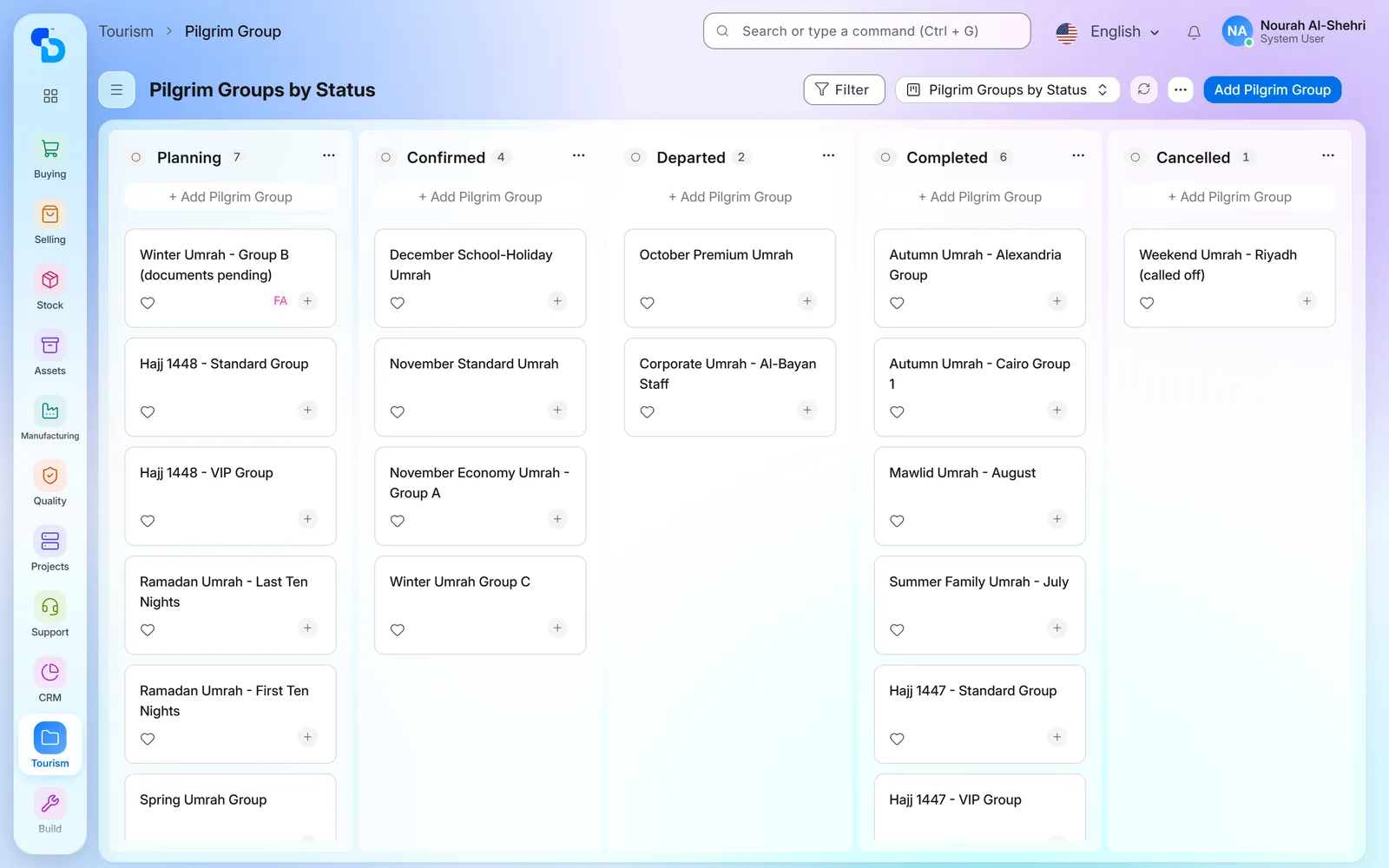
Invoices, supplier balances and profit
Once a file is submitted, staff create its invoices from the rows they select. The system groups customer invoices by currency. Supplier invoices are created per supplier, one currency at a time or one invoice per line. Because every invoice carries its file, you can read ERPNext’s receivable, payable and ledger reports per file. The file itself also shows its total cost, its total selling and its margin. For pilgrim groups, a report compares planned cost, selling and margin per group. The Command Center lists overdue payments and instalments past due.

Screens show demo data.
Solutions, ERPNext modules and integrations used for travel
One chart of accounts for every branch, multi-currency invoices and payments, and financial statements.
Customer invoices for tickets, packages and services, posted to the customer’s account.
Bills from airlines, hotels and tour suppliers, approved in sequence before payment.
Leads and deals tracked by stage, with quotations, linked to sales and accounts.
Vehicles, office equipment and branch fit-outs, with depreciation posted to the accounts.
Stock of travel documents, vouchers and merchandise per branch and warehouse.
Packages by room basis, pilgrims, group visas, rooming lists, the ministry export and group profit.
Bank loans, overdrafts and deposits, with their limits, interest and repayments.
Received and issued cheques from deposit to collection, each step with its journal entry.
ERPNext invoices cleared and reported to ZATCA, with the QR code on the print.
Invoices and credit notes sent to the Egyptian Tax Authority, with the status of each one.
Flight search from inside the travel system, with the chosen fare added to the quotation or booking.
Approved WhatsApp templates sent from ERPNext when documents change.
Where we have delivered ERPNext for a travel company
A travel and tourism company in Saudi Arabia
Travel agency: ticketing, hotel bookings and tour packages · Saudi Arabia
One set of books for every branch.
- One chart of accounts, with every branch posting to the same ledger
- Ticket, package and service invoices recorded in Sales and posted to the customer's account
- Bills from airlines, hotels and tour operators approved in sequence before payment
- An asset register with depreciation schedules
- Stock of documents, vouchers and merchandise per branch and warehouse
- A combined financial view for one branch or for the whole company
- Accounting
- Sales
- Purchasing
- Inventory
- Fixed Assets
Travel agency · Egypt and Saudi Arabia
Travel operations on the Customer File · Egypt and Saudi Arabia
Every service of a trip on one Customer File.
- A Customer File for each trip, with its own number
- Trips classified as incoming, outgoing or domestic
- Six service tabs: Hotel, Visa, Transfers, Airport Services, Aviation, and MICE and Others
- Supplier, cost and selling price on every service row
More ERPNext screens for travel agencies
Three more screens of ERPNext for travel agencies from the demo sites: the Umrah desk, a group manifest and a foreign-currency supplier invoice.
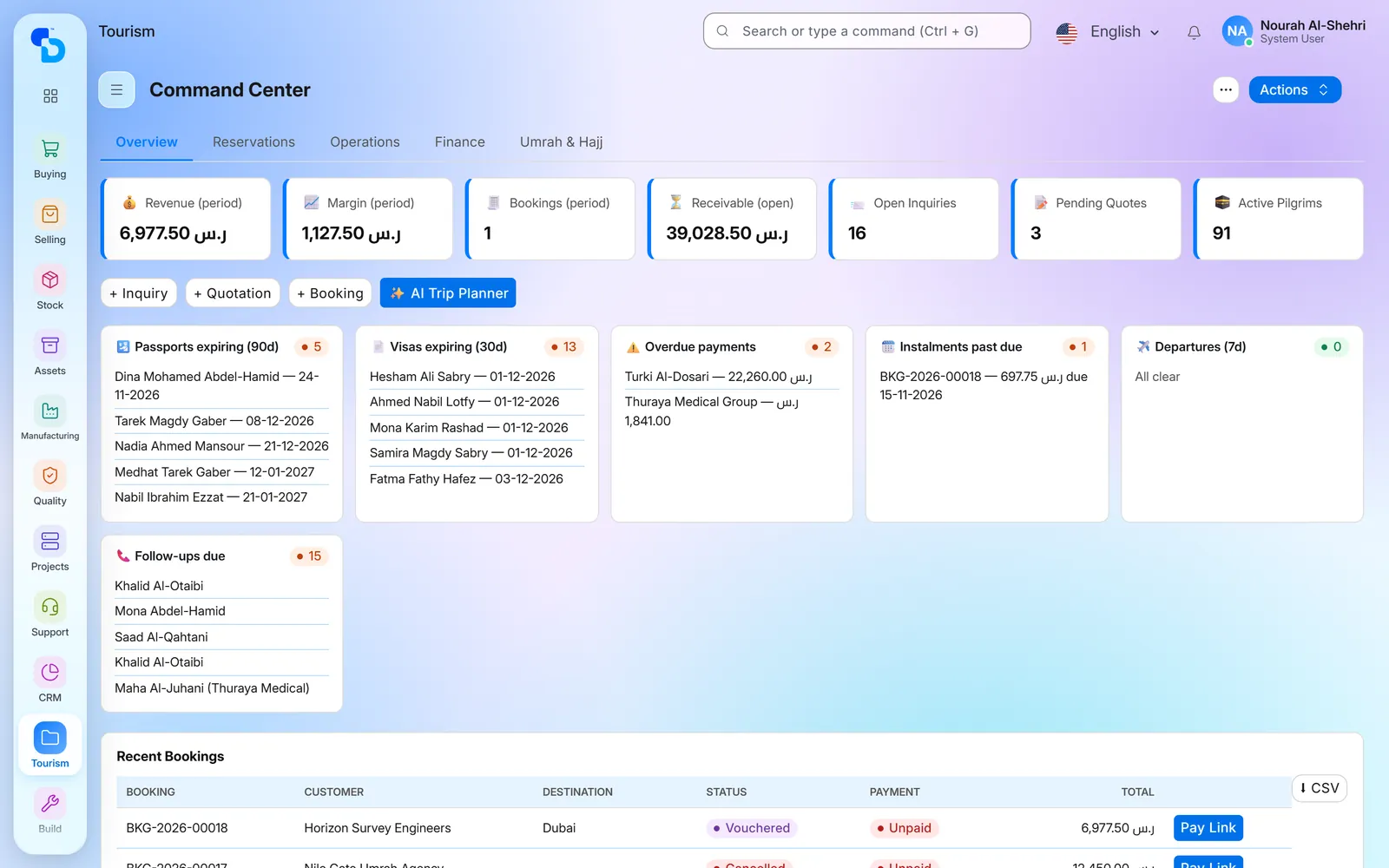


Screens show demo data.
Frequently asked questions
Does ERPNext for travel agencies also fit Hajj and Umrah operators?
Yes, because travel bookings and Hajj and Umrah groups share customers, suppliers and accounts in one system. Our Hajj and Umrah solution also adds packages by room basis, group visas, rooming lists and the ministry export.
Have you implemented ERPNext for a travel company before?
Yes. We implemented ERPNext accounting, sales, purchasing, inventory and fixed assets for a multi-branch travel company in Saudi Arabia. We also delivered our Customer File travel system in Egypt and Saudi Arabia. The other travel operations on this page come from our own travel system, which runs on ERPNext. Its enquiry pipeline and its Hajj and Umrah groups are on a demo site with fictional data.
How do air tickets get into the system?
Tickets come from the interface files that Amadeus writes for your office. The system reads each file and records the ticket in ERPNext, and voids and refunds follow the same route.
Can we reconcile the BSP statement?
Yes. You attach the statement as a CSV or Excel file, and the system matches each line to your own ticket. It then marks the line as matched, different in amount or not in the system. However, it does not read the fixed-width HOT file.
Can we search flights from inside the system?
The travel system has connectors that search flights through the Amadeus and Duffel APIs. Staff then add the chosen fare to a quotation or a booking as a flight line. Each connector needs your own account with the provider, so we set it up during the project.
Do you handle suppliers and customers in other currencies?
Yes. Each service line keeps its cost currency, its selling currency and the exchange rate applied. Supplier invoices also stay in the supplier’s currency. When you pay or collect at a different rate, ERPNext posts the exchange difference.
Does ERPNext support e-invoicing for travel agencies in Egypt and Saudi Arabia?
Yes, through our integrations. ERPNext invoices are reported to ZATCA Phase 2 in Saudi Arabia and sent to the Egyptian Tax Authority in Egypt. We set up e-invoicing as part of the project, after we agree each part with your finance team.
Is this standard ERPNext for travel agencies, or custom work?
Both. Accounting, sales, purchasing, inventory and fixed assets are standard ERPNext modules. The rest, including enquiries, bookings, the Customer File, tickets, visas and pilgrim groups, comes from our travel system, an app that runs on top of ERPNext.
Related industries
The industries we have delivered in, each with its own page.
Sales, purchasing, multi-warehouse stock, price lists, cheques and online stores in one system.
Admissions, timetables, attendance, grades and fee collection for schools, plus online courses for training centres.
Units, leases, rent and service charges, maintenance and parking for malls and commercial towers.
Running a travel agency? See ERPNext on a demo
Tell us how you sell, operate and settle with suppliers. We will then walk you through ERPNext for travel agencies on a demo site: a booking, a group and its profit.
Free demo · No commitment