Industries · Manufacturing · ERP for glass manufacturing
ERP for glass manufacturing, built on ERPNext
See what each line produced, how long each machine stood still and what is ready to ship. Our ERP for glass manufacturing runs on ERPNext as one system, from the furnace to the export container.
We have implemented ERPNext for a glass manufacturer in Egypt.
Cullet booked on every production entry
Downtime by machine, with its reason and the time lost
Quality inspection before raw materials enter stock
Export orders by Incoterm, with packing slips
The process
From the furnace to the container, in one system
1
Orders and planning
Open sales orders feed the production plan.
2
Melting
Each forming machine draws molten glass from its furnace.
3
Forming
Each forming machine is a workstation with its own hourly cost.
4
Inspection and packing
Good ware is packed on pallets, while rejected ware is booked as cullet.
5
Finished stock
Finished ware enters the finished-goods warehouse.
6
Loading and export
Delivery notes and packing slips then follow each order out.
7
Accounts
Each movement posts its value to stock and the ledger.
Problems we solve
What glass manufacturing struggles with, and how the ERP answers
In glass manufacturing, the furnace never stops
A furnace melts around the clock, so every unit a line fails to pack is glass already melted and paid for.
Each production entry books good ware and cullet, and the cullet value comes off the cost of the good ware.
A stopped line still costs
When a forming machine stops, the glass keeps flowing. If the stop sits only in a logbook, nobody adds up its cost.
A downtime entry records the machine, times, operator and reason, and a report adds up the hours lost per machine.
Stock items and special orders share the lines
Fast-moving ware is made for stock, while special ware is made to order. In a spreadsheet, a shortage stays hidden until a customer asks.
The production plan pulls open sales orders and creates work orders and material requests, while each stock item keeps a reorder level per warehouse.
A new article is a project
A new bottle or glass needs a mould, samples, a pack design and an offer, but each thread sits with a different team.
For a glass manufacturer in Egypt, we built one new-product record that holds the customers, line, mould status, tasks and profit per ton.
Glass ships by the pallet and the container
An export order is promised in containers, loaded in pallets and invoiced with FOB and freight, so a quantity alone says little.
Sales orders carry the currency and Incoterm, and packing slips list each package with its net and gross weight.
A claim touches every department
A claim about defects involves quality, packing, logistics and finance, so without one record the answer and the credit note drift apart.
For a glass manufacturer in Egypt, we built a claim record that carries the problem, the defect rate, the actions and the approved compensation.
What we set up
What we set up in an ERP for glass manufacturing
Eight things we have built or configured for a glass plant. Each one says what standard ERPNext does and what we added for a glass manufacturer in Egypt.
Glass manufacturing yield: good ware and cullet on every production entry
Each production entry books the good ware into finished stock and the cullet into the stores. The bill of materials lists cullet as scrap, so its value comes off the cost of the good units. For a glass manufacturer in Egypt, we also added pack-to-melt. There, each entry compares the good units with the molten units drawn by the machine, and a report lists the entries by date, shift and machine.
Work order summary for the period (general manufacturing demo)
Line downtime by machine and reason
When a forming machine stops, a downtime entry records the machine, times, operator and a listed reason. The entry works out the minutes lost, and a report adds them up per machine. For a glass manufacturer in Egypt, we also added the furnace and the molten units lost to each stop. That project also keeps a daily labour record per workstation, with labour requests by area and shift.
Work orders by status (general manufacturing demo)
Make-to-stock planning for glass manufacturing
In standard ERPNext, each stock item keeps a reorder level and a reorder quantity per warehouse. For a glass manufacturer in Egypt, we built a planning report on top. The report reads the sales invoices of a chosen period and works out average monthly sales. It then shows finished stock, months on hand and a status such as ‘Potential Shortage’. It also counts open sales orders and running work orders, then proposes a quantity to produce.
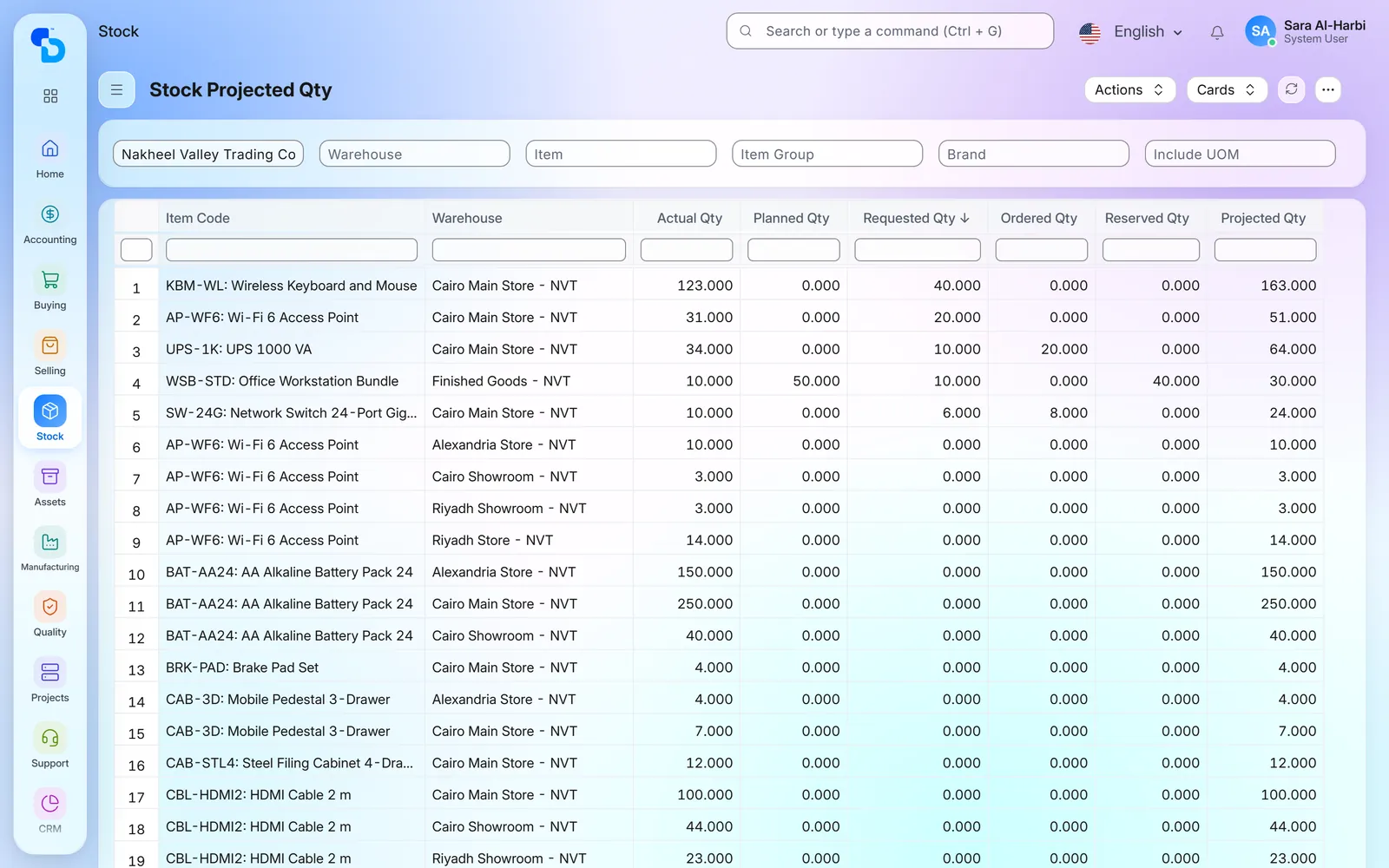
Stock by item and warehouse: actual, planned and requested quantity (general ERPNext demo)
Sales orders in the production plan
The production plan pulls open sales orders and lists what to make with planned start dates. It then creates work orders and material requests. For a glass manufacturer in Egypt, we built a planning screen that also sets the supply for each order line: from stock, from production or both. There, every item lists its machines with a speed and an efficiency, so the plan turns each quantity into machine hours. A promise report also shows who set each promise date, and when.
A production plan with the item to manufacture (general manufacturing demo)
New products: mould, samples and profit per ton
For a glass manufacturer in Egypt, we built a new-product record. It holds the target customers and their annual demand, as well as the line, the weight and cycles per minute. It also states whether a mould is available and who owns it. Offers and costs are entered per unit, and the record then converts them to a value per ton. A task list follows the launch steps, and sample requests follow each shipment of samples. In standard ERPNext, the leads and opportunities behind a new article sit in CRM.
A sales opportunity with its stage and expected closing date (general ERPNext demo)
Packaging requests for containers and tableware
In standard ERPNext, the bill of materials of each article lists its packaging materials, such as cartons, next to the glass. For a glass manufacturer in Egypt, we built packaging requests that differ by product family. The container-glass request names the product, the units per pack and the pack type, such as a pallet, box or shrink pack. For tableware, the request instead sets the inner and outer capacities and the kind of sleeve, gift box or sticker.
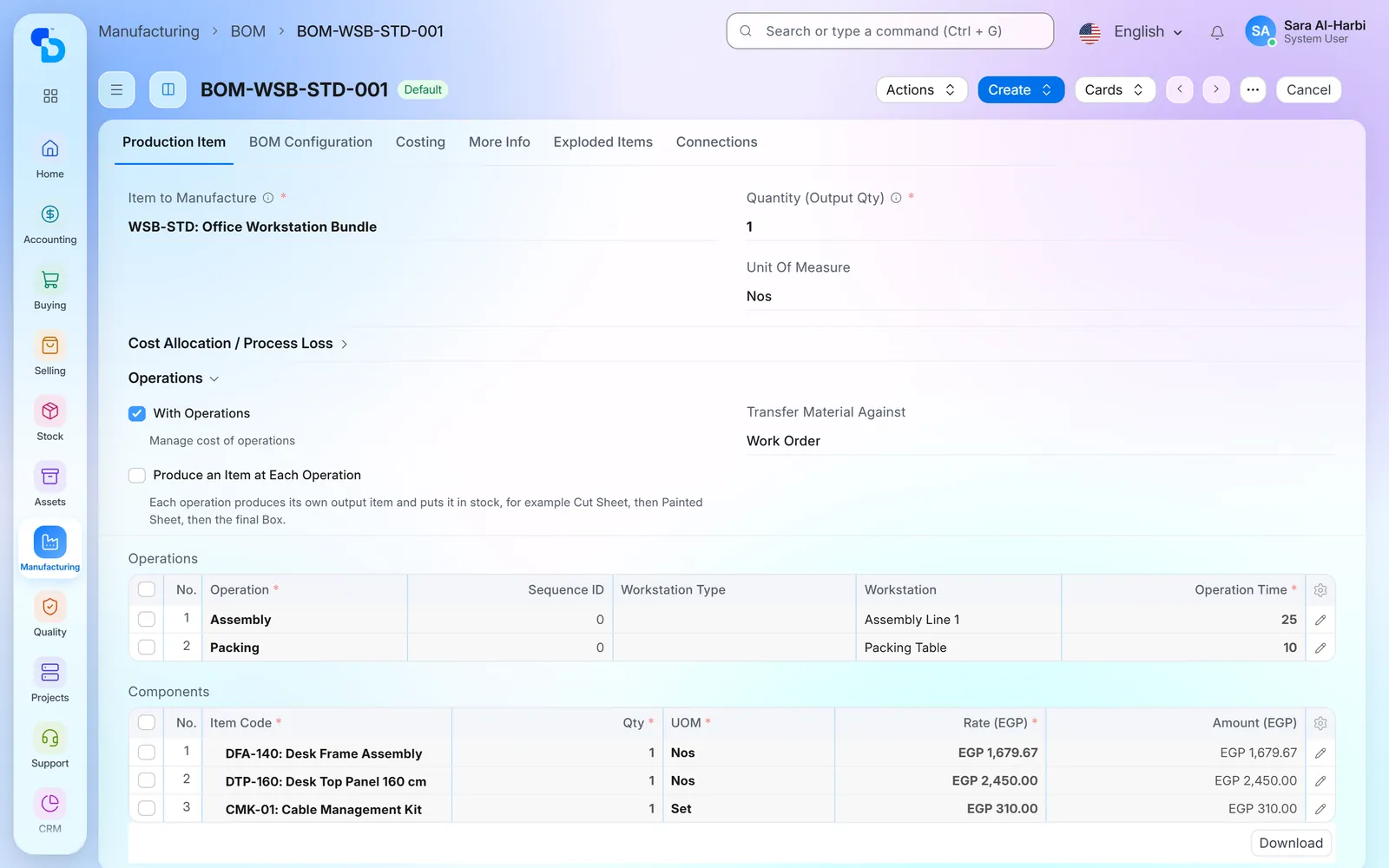
A bill of materials with its components and costs (general manufacturing demo)
Export orders by Incoterm, with packing slips
The export sales order carries its currency, the Incoterm such as FOB and the named port. Packing slips then list the packages of each delivery with their net and gross weights. For a glass manufacturer in Egypt, we added the container count, the FOB and freight totals and export-subsidy lines to the order. We also built a loading request that pulls only the quantities not yet requested. A shipping report there lists the booking number, ports and sailing dates per invoice.
A delivery note with the delivered items and totals (general ERPNext demo)
Customer claims, actions and compensation
For a glass manufacturer in Egypt, we built a customer claim record. It is registered against the customer, the sales order and the product, with the nature of the problem and the defect rate. Corrective and preventive actions are then assigned as tasks with due dates. If compensation is approved as an amount, the claim creates the credit-note journal entry. A customer survey also covers quality, service, delivery and invoicing.
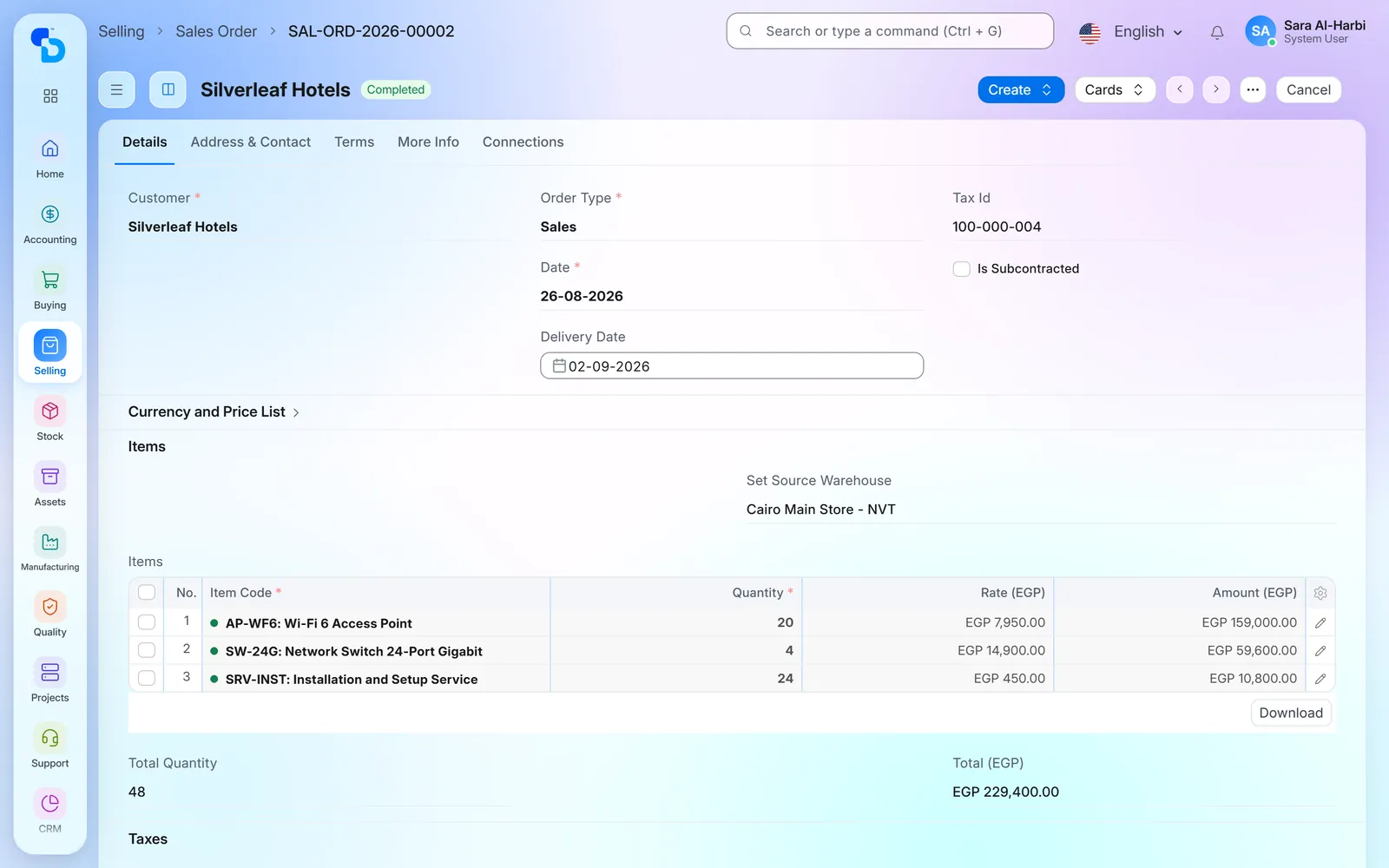
A sales order with delivery dates (general ERPNext demo)
Screens show demo data.
Modules
Modules, integrations and solutions for glass manufacturing
Production, planning, export and accounts in one system.
Manufacturing
Inventory
Sales
Purchasing
Accounting
Fixed Assets
CRM
What we set up
Pack-to-melt per shift and machine
Downtime entries with the units lost
Make-to-stock planning and line scheduling
New-product records, sample requests and coding requests
Packaging requests for containers and tableware
Loading requests and a shipping report for export
Customer claims with actions and compensation
Post-dated cheques and Egyptian e-invoicing
Screens
Standard ERPNext screens a glass plant uses daily.
A work order: required materials against the quantity to produce (general manufacturing demo)
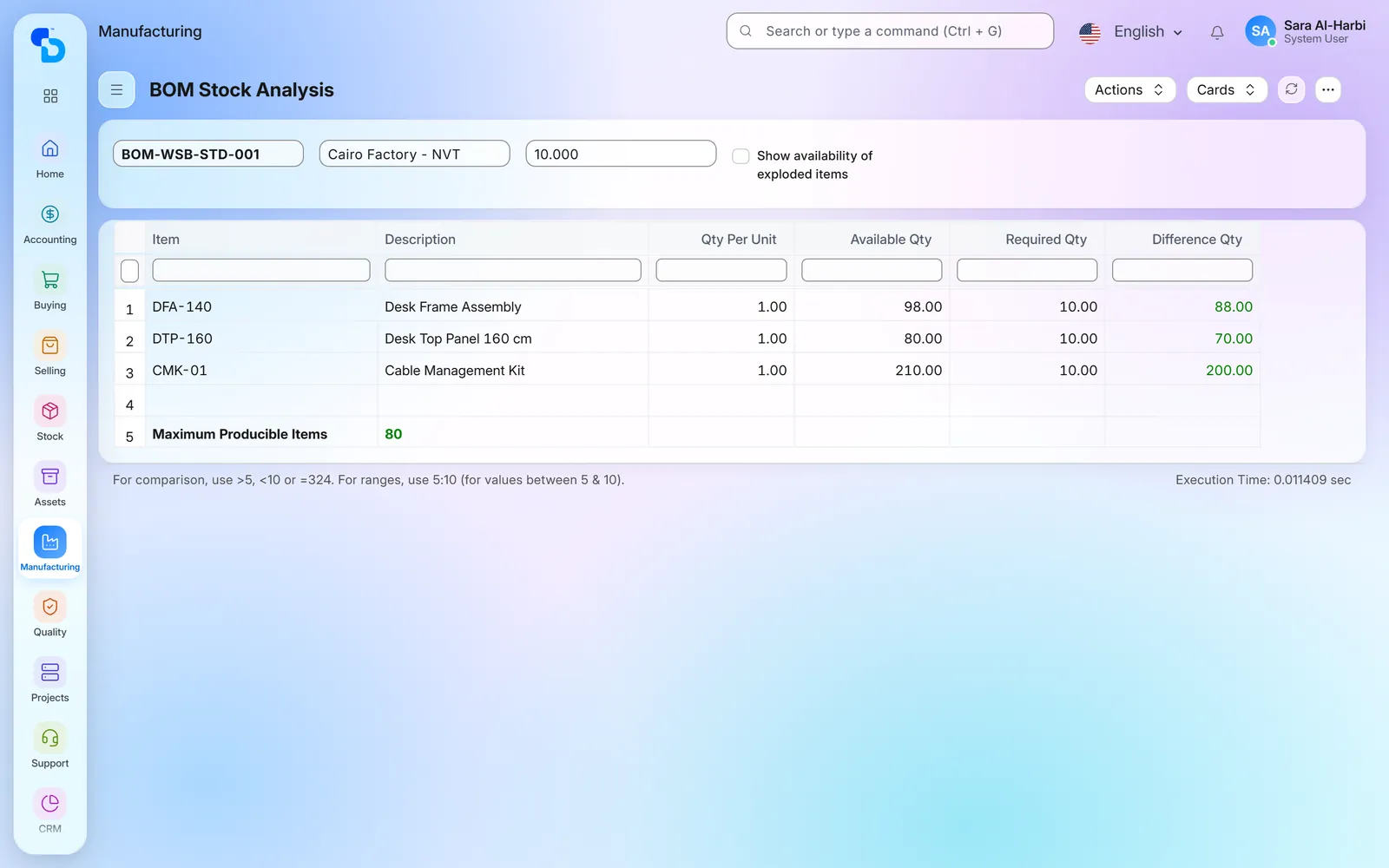
BOM stock report: required against in-stock quantity (general manufacturing demo)
Every stock movement in order (general ERPNext demo)
A purchase receipt into the stores (general ERPNext demo)
Screens show demo data.
FAQ
Questions about ERP for glass manufacturing
Have you implemented an ERP for glass manufacturing before?
Yes, for a glass manufacturer in Egypt. The project covers accounting, stock, sales, purchasing, manufacturing, fixed assets and CRM, and adds glass-specific records such as pack-to-melt, downtime and loading requests.
How does the ERP calculate pack-to-melt for glass?
In the project we delivered for a glass manufacturer in Egypt, the system multiplies an entry’s running time by the machine speed to get the molten units, then divides the good units by them. A report lists the results by date, shift and machine. Standard ERPNext does not hold this ratio: it books good ware and cullet on the production entry.
Where does the ERP get the speed of a glass forming machine?
In standard ERPNext, a workstation holds its hourly costs, not a speed. For a glass manufacturer in Egypt, we added sections, cavities and cycles per minute to each workstation, and the system multiplies them into a speed.
Can one ERP plan make-to-stock and make-to-order glass on the same lines?
Yes. The standard production plan pulls open sales orders and creates work orders and material requests, while stock items keep reorder levels. For a glass manufacturer in Egypt, we also built a planning report by months on hand and a screen that supplies each order line from stock, from production or both.
Does the ERP handle export orders for glass?
Yes. Orders carry the currency, the Incoterm and the named port, and packing slips list each package with its weights. For a glass manufacturer in Egypt, we also built loading requests and a shipping report.
Is this ERP for glass manufacturing standard ERPNext or custom work?
Both. Bills of materials, work orders, job cards, stock, purchasing, sales and accounts are standard ERPNext. Pack-to-melt, the planning tool, new-product records, packaging and loading requests and customer claims are additions we built for a glass plant. On a new project, we adapt them to that plant’s process.
Does it support Egyptian e-invoicing and post-dated cheques?
Yes. Our ETA integration sends sales invoices from ERPNext to the tax authority, then keeps the returned status on each invoice. Post-dated cheques are also followed on the payment entry until collection.