

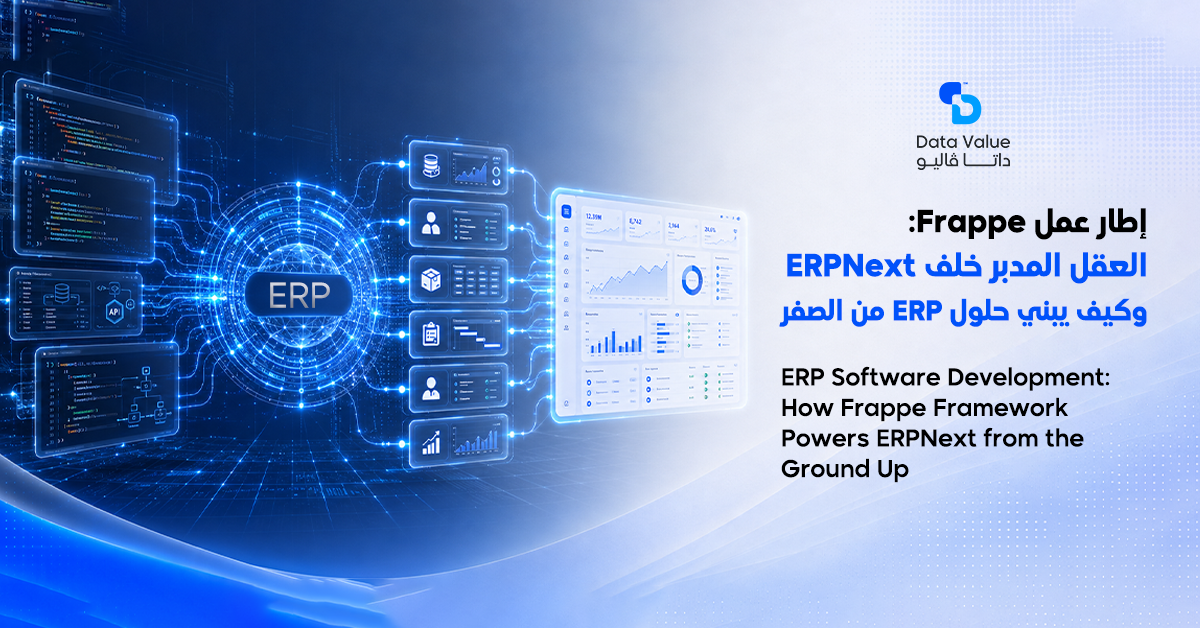
Choosing the right foundation for ERP software development can determine whether a system truly fits your business.
Frappe framework offers flexibility without unnecessary complexity, and at Data Value, we rely on it to build systems around real operational needs.
This article explains how Frappe supports ERP software development, from planning to deployment.
Table of Contents
An Overview of the Frappe Framework in ERP Software Development
Frappe is a full-stack, Python-based web framework built specifically to accelerate business application development.
It comes with ready-made building blocks for user management, permissions, workflows, and reporting.
As a result, teams working on ERP software development don’t need to start from scratch on every project.
Frappe is also recognized as a Python web framework that pairs a structured backend with a flexible front end, making it well suited to complex business logic. Because it follows an MVC architecture, developers can separate data, logic, and presentation cleanly, which keeps large ERP projects maintainable over time.
According to Softices, this structure is one of the main reasons the framework has gained traction among ERP developers.
Why Frappe Framework Development Stands Out for ERP Software Development
Businesses today need systems that adapt to their processes rather than the other way around. Frappe framework development gives teams that flexibility by exposing a business application framework that can be extended without touching the core codebase.
Learn more about our approach on the Data Value Who Are We?
How Frappe Supports Custom ERP Development for Growing Businesses
No two companies run identical operations, which is why ERP software development often requires more than a generic template.
Frappe’s DocType system allows teams to define custom data structures without writing extensive boilerplate code. This makes DocType development one of the fastest ways to model real business entities, from purchase orders to project milestones.
On top of this, Frappe powers ERPNext, the most widely used open-source ERP framework built on the platform, covering accounting, inventory, sales, and HR out of the box.
However, companies with more specific requirements often pursue custom ERP development on top of ERPNext rather than building a standalone system, which saves both time and budget. You can review the ERPNext repository on GitHub for a closer look at its module structure.
The Stages of ERP Software Development Using Frappe
Every project begins with requirements analysis to understand current processes and pain points. From there, the team moves into data modeling, development, and testing. The final stages include data migration from legacy systems and a controlled go-live, followed by ongoing support once the system is in daily use.
Read next:
The Advantages of an Open-Source ERP Framework for ERP Software Development
Working with an open-source ERP framework gives businesses direct visibility into how their system actually works. Because the source code is accessible, teams are not locked into a single vendor or forced to accept opaque licensing terms.
This matters most in ERP software development projects with unusual operational rules that off-the-shelf software can’t accommodate.
Frappe also functions as a low-code ERP platform, speeding up the creation of forms, reports, and dashboards without heavy custom coding.
In addition, its built-in API layer simplifies integration with e-commerce platforms, payment gateways, and government portals. This combination makes building an ERP system from the ground up considerably more approachable than it used to be.
For a non-technical explanation of these capabilities, see this Wahni guide for business owners.
Custom ERP Development vs. Off-the-Shelf: What ERP Software Development Should Consider
Frappe bridges both approaches. Teams can start from ERPNext’s ready-made modules and layer custom ERP development on top as requirements evolve. This also applies to deployment: businesses can choose a cloud or on-premise setup depending on data governance policies, without giving up the ability to shape the system around their actual workflows.
ERP Software Development with Frappe Across Different Industries
Frappe’s adaptability becomes clear once you look across industries. Construction companies rely on ERP software development to manage project costs, subcontractors, and procurement in one place. Manufacturers, by contrast, need stronger support for production planning, bills of materials, and raw material tracking.
E-commerce businesses require tight integration between their storefront and back-office operations, while government entities need reporting and governance features baked into the platform.
This range of use cases is why an experienced ERP implementation partner matters as much as the technology itself. See real examples on our success stories page.
Choosing the Right ERP Implementation Partner for ERP Software Development
A capable partner brings more than technical knowledge of the framework. Look for a team that treats ERP customization as an ongoing service rather than a one-time setup, and that has delivered projects across sectors similar to yours. Visit Data Value to explore our full range of services.
Read next:
Conclusion: ERP software development
Frappe has become one of the most practical foundations for ERP software development that genuinely fits how a business operates. Its open-source ERP framework structure, combined with the strength of ERPNext and the flexibility of custom ERP development, offers a rare balance of speed, cost, and control.
Whether a company works in construction, manufacturing, e-commerce, or government services, this framework adapts to real operational needs rather than forcing a rigid template onto them.
Ultimately, the right ERP implementation partner is just as important as the technology itself, since execution quality shapes the outcome of any project.
Data Value brings hands-on experience building Frappe-based systems tailored to regional and local market requirements, from initial analysis through long-term support.
If your business needs a reliable system built around how you actually work, now is a good time to explore what’s possible. Request a free demo with the Data Value team today to discuss your next project in detail.
FAQ About ERP Software Development
What makes Frappe a strong choice for ERP software development?
Frappe combines a mature Python backend with a flexible data modeling layer, which shortens development cycles significantly. Teams working on ERP software development benefit from ready-made modules for permissions, workflows, and reporting instead of building these from scratch. This lets developers focus on business logic rather than infrastructure. Request a free demo to see the framework in action.
How long does a typical ERP software development project take?
Timelines vary based on company size and process complexity, but mid-sized projects typically run two to four months including analysis, development, and testing. Starting from ERPNext’s existing modules can shorten this considerably compared to building everything from scratch. Request a free demo to get a realistic timeline for your specific scope.
Is Frappe suitable for small businesses pursuing ERP software development?
Yes, Frappe works well for small and mid-sized companies thanks to its lower licensing costs and modular structure. Businesses can start with core modules and expand the system gradually as operations grow. This makes ERP software development financially realistic even for teams without large IT budgets.
What is the difference between Frappe framework development and ERPNext?
Frappe is the underlying business application framework, while ERPNext is a complete application built on top of it, covering accounting, inventory, and HR. Frappe framework development refers to building or extending applications using the core framework directly. Many ERP software development projects use ERPNext as a starting point and add custom modules through Frappe framework development.
Does ERP software development on Frappe support integration with other systems?
Yes, Frappe includes a built-in REST API layer that makes it straightforward to connect payment gateways, e-commerce platforms, and third-party services. This means companies don’t need to abandon existing tools when adopting a new ERP system. Integration capability is often a deciding factor in ERP software development for businesses with an established tech stack. Book a free demo to review integration options for your current systems.
How does the cost of ERP software development with Frappe compare to off-the-shelf systems?
Because Frappe is an open-source ERP framework, license costs are lower than closed, proprietary alternatives.
That said, total project cost still depends on the level of customization, number of users, and modules required. Over time, ERP software development on this framework tends to offer better value than expensive off-the-shelf licensing models. Request a free demo to get a cost estimate based on your requirements.
How does Data Value approach ERP software development for a new client?
Data Value begins with a detailed analysis session to understand existing processes and operational gaps. From there, the team proposes a structure combining ERPNext’s ready modules with any necessary custom ERP development. Development and testing follow before moving into go-live and ongoing support.