

Getting ERPNext security compliance right is the first question most decision-makers ask before adopting any ERP system.
As cyber threats grow and regulators tighten data protection rules, businesses need a platform that keeps sensitive information safe while meeting local and international requirements. Data Value builds ERPNext solutions designed to meet exactly these demands with confidence and operational efficiency.
Table of Contents
Why ERPNext Security Compliance Is a Strategic Priority for Businesses
Companies today handle massive volumes of financial, operational, and customer data. Because of this, ERPNext data security has become a core requirement rather than a nice-to-have feature. A single data breach can cost a company direct financial losses and lasting reputational damage.
In addition, regulators across the region are enforcing stricter rules around personal data protection and electronic invoicing.
As a result, ERPNext security compliance has become a fundamental criterion when evaluating any resource planning system. Companies that ignore this dimension expose themselves to growing legal and financial risk.
The Data Value team works with clients to assess these risks from the very start of an implementation project, not after something goes wrong.
This proactive approach saves time and cost over the long run, and gives leadership a clear view of how ready their system really is.
How Do Cyber Threats Impact ERPNext Security Compliance?
Cyberattacks have grown more sophisticated, and they specifically target systems holding sensitive financial and operational data. When ERPNext security compliance is weak, the likelihood of data leaks or operational disruption rises sharply.
Therefore, businesses need a system that provides multiple layers of protection, starting at the user level and extending all the way to the database itself.
Key Features That Strengthen ERPNext Security Compliance
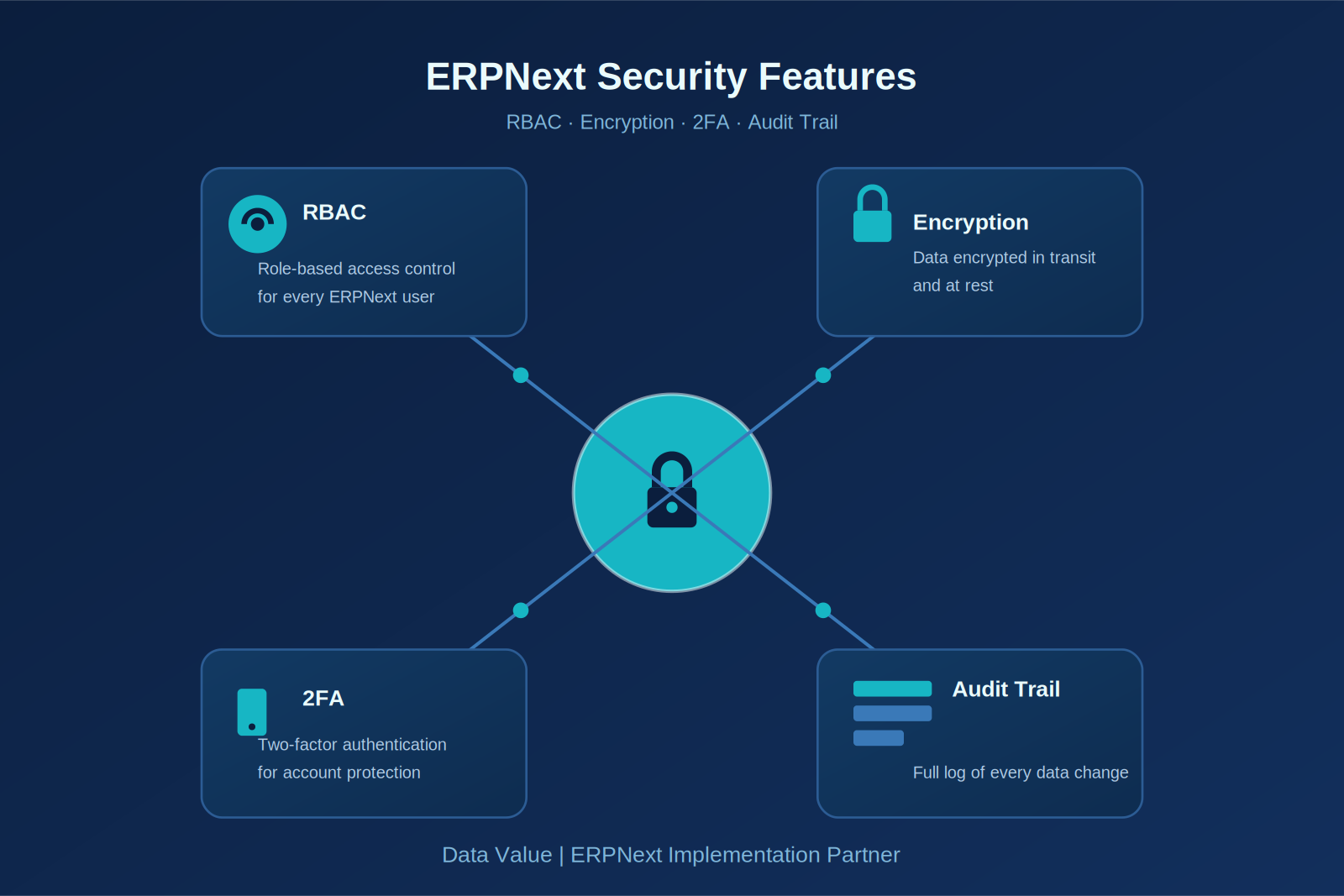
ERPNext relies on a set of technical capabilities that deliver a high standard of ERPNext data security. First, the platform provides role-based access control, allowing every user to reach only the data tied to their responsibilities.
This significantly reduces the risk of internal misuse.
Second, the system supports data encryption both in transit and at rest, so information stays protected whether it’s stored or moving between systems.
On top of that, two-factor authentication (2FA) adds an extra layer of protection that blocks unauthorized access, even if a password is compromised.
ERPNext also maintains a detailed audit trail that logs every change made to the data, which makes review and investigation far easier when needed. Beyond that, the platform relies on automated backup & disaster recovery routines and SSL certificates to keep operations running and secure the connection between users and the server.
Together, these capabilities form a strong foundation for ERPNext security compliance.
If you’re exploring how to tailor these permissions to your specific business, take a look at our article on custom ERP configuration on the Data Value blog.
How Do User Permissions Strengthen ERPNext Security Compliance?
ERPNext user permissions are far more than a technical setting — they’re the first line of defense against mistakes and internal misuse.
When a manager defines exactly who can view, edit, or delete each type of data, the system becomes far easier to monitor and audit.
This precise structure directly supports ERPNext regulatory compliance across the organization.
ERPNext Regulatory Compliance: Aligning With Local and International Laws
Compliance requirements vary by industry and country, but ERPNext security compliance gives businesses the flexibility to adapt to nearly any of them.
For example, the system can be configured to align with European GDPR requirements when handling EU customer data, or with HIPAA in healthcare settings that manage patient records.
Across the Middle East, aligning with Personal Data Protection Law (PDPL) has become essential for Saudi and Gulf-based companies. ERPNext also supports e-invoicing compliance in line with ZATCA requirements, which matters enormously for any business operating inside the Saudi market. This alignment reduces the risk of penalties and keeps operations running without interruption.
According to an analysis published by 4devnet, ERPNext helps organizations streamline reporting and compliance processes through automated transaction logging and workflow management.
A related report from ipconnex highlights how important it is for companies to fully understand data protection requirements before rolling the system out in sensitive work environments.
How Does ERPNext Security Compliance Support E-Invoicing and Tax Requirements?
Tax compliance demands precise transaction records that link directly to official authorities. ERPNext provides mechanisms to issue electronic invoices and generate tax reports automatically, reducing manual errors and improving a company’s readiness for future audits.
Read next:
Choosing the Right ERPNext Hosting for Strong Security Compliance
The strength of your ERPNext security compliance depends partly on the hosting model you choose.
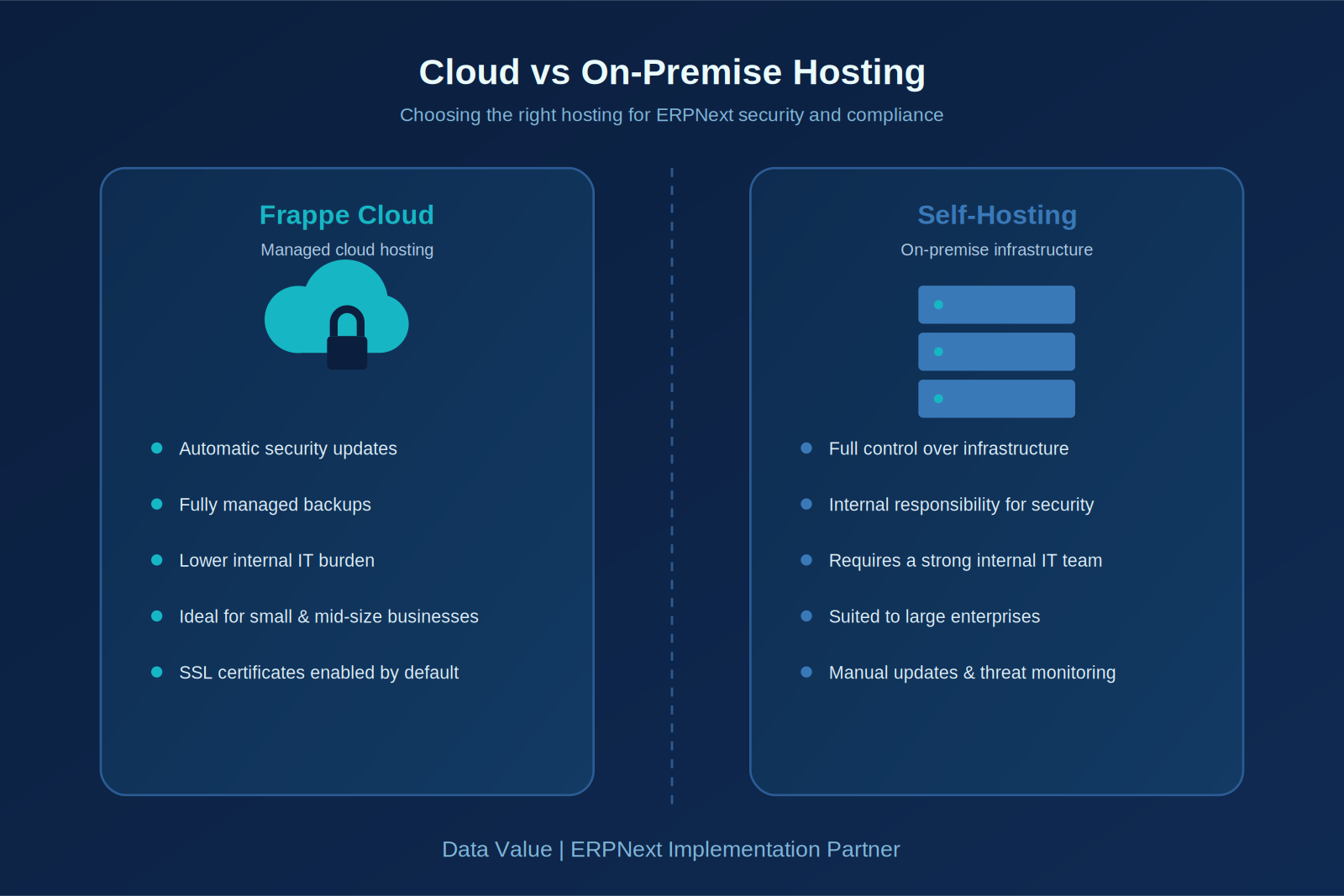
Frappe Cloud offers a fully managed cloud hosting environment that includes regular security updates and automated backups, a solid option for companies that want to minimize internal technical overhead.
For more technical detail, see the official ERPNext page on security and hosting.
By contrast, self-hosting gives a company complete control over its technical infrastructure, but it also places full responsibility for security maintenance and updates on the internal team.
This route suits organizations with a strong internal IT team capable of continuously tracking emerging threats, a form of open-source ERP security that demands active in-house risk management.
Generally speaking, the hosting decision requires a careful evaluation of internal resources and regulatory requirements.
Companies handling sensitive financial data or customer information through a CRM system typically need a higher level of protection, regardless of whether they choose cloud or self-hosted infrastructure.
What’s the Difference Between Self-Hosting and Cloud Hosting for ERPNext Security Compliance?
Cloud hosting delivers continuous security updates managed by the provider, while self-hosting requires an internal team to track and apply those updates manually.
As a result, the cloud suits small and mid-sized businesses well, while larger enterprises may prefer self-hosting when they have the technical resources to support it.
Read next:
Conclusion: ERPNext security compliance
ERPNext security compliance is a core requirement for any company looking to protect its data while keeping pace with growing regulatory demands.
From user permissions to encryption and audit trails, these capabilities combine to deliver comprehensive protection that supports business continuity and reduces legal and financial exposure.
Whether your company operates in healthcare, finance, or commerce, choosing the right hosting model and configuring the system correctly determines how effective this protection really is. Data Value helps businesses achieve exactly that through a well-planned implementation methodology tailored to each sector’s needs.
Don’t leave your data security to chance. Contact the Data Value team today and request a free demo to see how ERPNext can protect your company’s data and ensure full regulatory compliance.
Frequently Asked Questions About ERPNext Security Compliance
What does ERPNext security compliance actually cover?
ERPNext security compliance refers to the combined set of technical and organizational measures that protect a company’s data and ensure alignment with applicable regulations. This includes encryption, user permissions, and audit logs.
It matters to your business because it reduces the legal and financial risk tied to data leaks. Request a free demo to see how the system applies these standards in practice.
How does Data Value ensure ERPNext security compliance for its clients?
Data Value follows an implementation methodology that starts with a security and regulatory risk assessment for every client before configuration begins.
From there, permissions, encryption, and backup settings are tailored to the nature of the business. This ensures that ERPNext security compliance matches the specific needs of each sector.
Does ERPNext security compliance support GDPR and HIPAA requirements?
Yes, the system can be configured to align with GDPR when handling EU customer data, and with HIPAA when processing sensitive healthcare records. This is achieved by adjusting permissions, encryption, and audit logging to meet the requirements of each regulation. This flexibility makes ERPNext security compliance adaptable across multiple industries.
How much does it cost to implement ERPNext security compliance?
Cost varies depending on company size, number of users, and the hosting model selected. Some baseline ERPNext security compliance settings are already built into the platform, while advanced configurations require dedicated technical consulting. The best approach is to evaluate actual needs before setting a budget.
Is ERPNext security compliance strong enough for large enterprises?
ERPNext offers robust security capabilities suited to mid-sized and large organizations, especially when paired with professionally managed hosting.
That said, larger enterprises often need additional customization and more complex permission policies. This can be achieved through careful configuration that accounts for the scale of operations.
How do I start improving ERPNext security compliance for my company?
The process begins with assessing your current user permissions, backup policies, and encryption settings. From there, a phased plan is put in place to update these settings in line with best practices.
This ensures ERPNext security compliance improves without disrupting daily operations.
Do ERPNext security compliance requirements differ across industries?
Yes, requirements vary significantly by industry. Healthcare organizations need stricter controls due to the sensitivity of patient data, while financial companies focus heavily on protecting transactions and reporting.
As a result, ERPNext security compliance must be configured to match the specific nature of each sector.