

Most companies today are drowning in data they don’t fully control, which is exactly why data governance has become non-negotiable. Without a clear structure, data turns from a strategic asset into a source of costly errors. In this guide from Data Value, we break down how to build a governance system your teams can actually trust.
Table of Contents
What Is Data Governance and Why Do Businesses Need It?
Data governance is the set of policies, roles, and processes that keep company data accurate, secure, and used correctly. It defines who owns each type of data, who can access it, and how it gets validated and updated over time.
Without solid data, errors pile up across departments, and teams waste hours reconciling numbers instead of making decisions.
At the same time, the risk of data leaks or non-compliant data use rises sharply.
Businesses need it because information volume keeps growing across an expanding number of systems and tools. Without a unified structure, that data becomes a liability instead of a genuine competitive advantage.
Data Governance vs. Data Management: What’s the Real Difference?
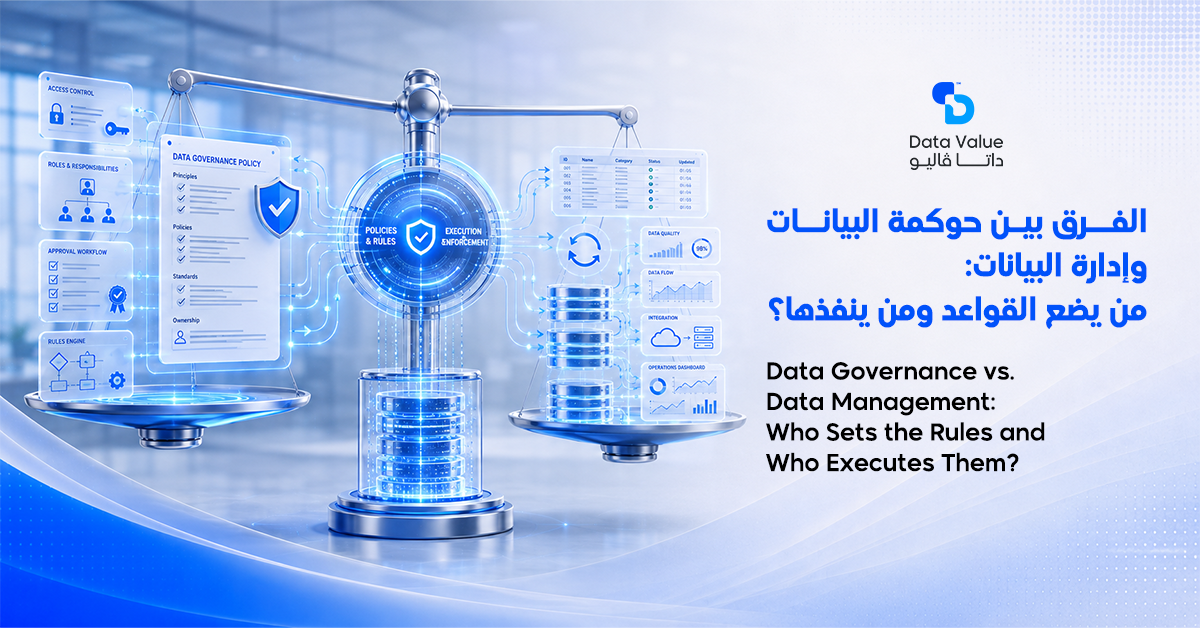
Business owners often confuse data governance vs data management, but the two concepts are distinct, even though they work together.
Data management handles the operational side — storing, processing, and technically securing data day to day.
On the other hand, is the strategic layer that defines the rules and accountability data management follows.
In short, governance sets the policy, and data management executes it.
This distinction matters when designing a data governance framework, because mixing up the two often produces strong technical systems with no real oversight or data accountability behind them.
Getting this right also depends on clear data ownership, so every dataset has someone responsible for its accuracy.
How to Build a Data Framework
Building a data framework starts with defining goals before choosing any tool. A company first needs to know exactly what it’s trying to achieve — better data quality, legal compliance, or stronger decision support.
Once goals are set, the next step is assigning data ownership for each department. Every dataset needs a clear owner accountable for its accuracy, rather than leaving responsibility scattered across teams with no real oversight.
Core Elements of an Effective Data Governance Framework
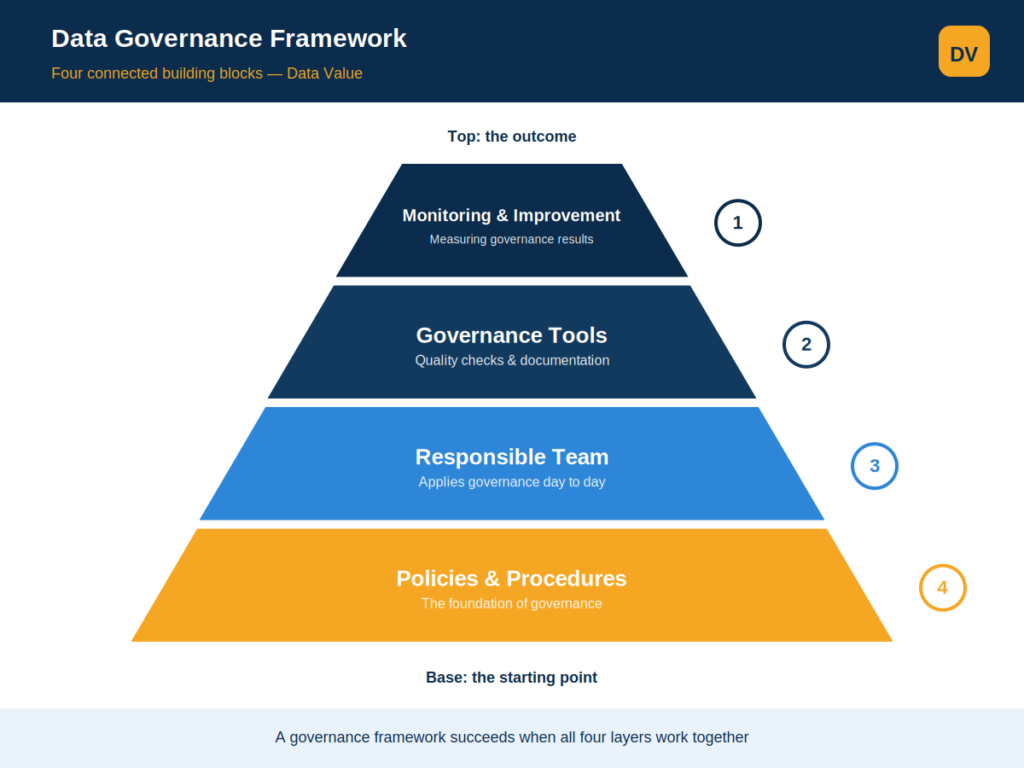
A strong data framework rests on several connected elements.
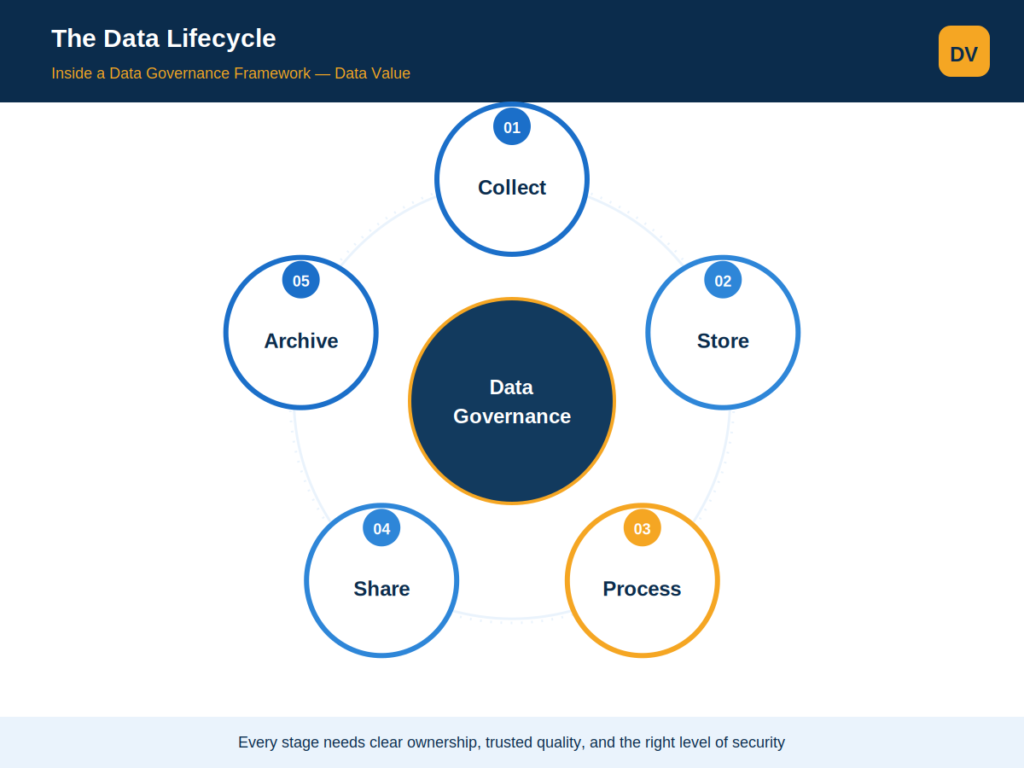
The first is a documented set of policies and procedures that define how data is collected, processed, and archived across its full lifecycle.
Second, the framework needs a data stewardship team responsible for applying these policies and tracking data quality indicators continuously. Third, the company needs the right tools to automate monitoring and documentation.
You can see how these elements come together in practice through Data Value’s success stories, where similar systems have been implemented for real businesses.
The Role of a Data Policy in Business Success
No framework succeeds without a documented data governance policy that everyone in the organization understands.
This policy determines who makes the final call when departments disagree about specific data.
A clear data policy also sets accepted data quality standards and defines how errors get handled once discovered.
This turns data handling into a structured process rather than a series of scattered individual decisions.
Read next:
Why Data Governance Improves Performance and Decision-Making
Data governance has a direct impact on the quality of management decisions. When leadership trusts the accuracy of its data, decisions become faster and more objective, instead of relying on personal judgment calls.
In addition, reduces costs tied to recurring mistakes, such as re-entering data or correcting financial reports. This frees up team time and increases overall productivity.
Data Quality Management, and Security
Data governance is closely tied to data quality management and data security. Strong governance ensures data stays accurate, current, and free of duplication across every connected system.
At the same time,strengthens data protection by defining precise access permissions. This lowers the risk of breaches or accidental internal exposure of sensitive information.
As Wikipedia notes, data governance also intersects closely with data privacy, master data management, and broader data quality initiatives across an organization.
Data Governance and Regulatory Compliance (GDPR/PDPL)
It has become directly tied to legal compliance, especially with Saudi Arabia’s Personal Data Protection Law (PDPL) now in effect. Companies without clear governance face real legal exposure.
Similarly, businesses operating internationally need data privacy compliance with GDPR when handling European customer data.
Strong data governance also supports alignment with cybersecurity standards, which reduces the risk of fines or legal action tied to non-compliance.
Enterprise Data Governance: How to Choose the Right Solution
When searching for an enterprise data solution, look beyond the technical tools alone. The right solution should fit how your company actually operates, not force a rigid model onto your teams.
It’s also important to assess your organization’s current data maturity before selecting any system.
This assessment reveals real weak points, whether in data quality or in unclear ownership across departments.
A piece published by Nozom Techs notes that linking data governance to enterprise management systems significantly improves compliance outcomes.
Data Governance in ERP Systems
ERP systems play a central role in putting data governance into practice across a business. When financial, operational, and HR data all live in one system, controlling quality and access becomes far easier to manage.
Modern enterprise platforms also integrate with AI capabilities, helping detect errors and analyze data quality automatically without constant manual intervention.
Learn more about Data Value’s integrated solutions on our About Us page, or visit our homepage to explore all our services.
Common Mistakes When Implementing Data Governance
One of the biggest mistakes is treating data governance as a purely technical, IT-only project. In reality, governance requires genuine participation from every department, not just one team.
Another common mistake is the absence of proper tools to measure performance and track compliance with approved policies.
Without measurement, it’s hard to know whether governance is actually working.
As SAP explains, successful data governance depends on continuity, not a one-time rollout that gets abandoned afterward.
Read next:
Conclusion
Data governance has become a core requirement for any company aiming for accurate decisions and more efficient operations. Through this guide, we covered what it means, how it differs from data management, and how to build an effective framework around it.
We also looked at its role in improving data quality management and security, along with its connection to regulatory compliance frameworks like GDPR and PDPL.
In addition, we showed how ERP systems make governance practical and enforceable in daily operations.
Companies that invest in Data governance today are building a stronger foundation for confident decision-making tomorrow.
If your business is looking for one integrated system that combines business management and data governance, the Data Value team is ready to help.
Book a free demo with Data Value today, and discover how one unified system can turn your company’s data into a genuine decision-making asset.
FAQ About Data Governance
What is data governance, and how is it different from data security?
Data governance is a comprehensive framework that defines data management policies and accountability, while data security focuses only on protecting data from breaches. Governance is broader because it also covers quality, ownership, and compliance. That’s why security alone can’t replace a full governance framework.
How long does it take to implement data governance?
Timelines vary by company size and number of systems involved, but most initial rollouts take between three and six months. The first phase covers assessing the current state, followed by building policies and tools. After that, companies need ongoing monitoring to keep improving results.
Is data governance necessary for small and mid-sized businesses?
Yes — even small companies handle customer data, vendor records, and financial transactions that require accuracy and protection. Skipping governance early on creates bigger problems as the company grows. In fact, implementing data governance tends to be easier for smaller businesses since their systems are less complex.
What’s the relationship between data governance and ERP systems?
Effective data governance depends heavily on having one unified system that consolidates company data, which is exactly where ERP systems come in. These systems let you apply access permissions and monitor data quality from a single place. Without a unified system, governance becomes harder because data is scattered across disconnected tools.
How does a company measure the success of its data governance program?
Data governance effectiveness is measured through specific indicators, such as data accuracy rates, error resolution speed, and adherence to approved policies. Success can also be measured by a drop in disputes over data ownership between departments. Reviewing these indicators regularly helps continuously improve the framework.
Who is responsible for implementing data governance inside a company?
Data governance is typically overseen by a dedicated team that includes representatives from IT, operational departments, and senior management. No single department can carry this responsibility alone, since data flows through every function in the business. That’s why successful governance needs clear support from senior leadership from day one.
Does data governance require specialized technical tools?
Yes — relying on manual effort alone makes data governance hard to sustain as data volume grows. Specialized tools help automate quality monitoring, access tracking, and change documentation. This reduces manual workload and noticeably improves accuracy.